Back to blog home
AI-Powered Access Control: The Next Generation of Building Security
by Team Rhombus, on May 12th, 2026
Physical SecurityTraditional access control verifies credentials and nothing more. Card readers and key fobs confirm a badge scan was valid, but they can’t tell you whether the right person is holding that badge, whether two people walked through on one swipe, or whether a 2 a.m. Saturday access attempt deserves an immediate response.
AI makes access control proactive. Instead of generating logs for post-incident review, an intelligent access control system identifies threats as they develop and pushes alerts in real time.
What Is AI-Powered Access Control?
AI-powered access control uses machine learning and computer vision to move past the binary question of “did this badge scan correctly.” These systems analyze behavior at entry points, detect anomalies in access patterns, correlate video with door events, and generate actionable intelligence in seconds.
Where traditional systems produce static logs, an intelligent access control system produces context. A denied swipe at a restricted door becomes far more useful when paired with video of the person attempting entry, the time of day relative to their normal schedule, and 30 days of access history.
How AI Is Transforming Access Control
Facial Recognition and Biometric Authentication
Computer vision enables touchless, credential-free entry. Authorized personnel gain access through facial recognition, eliminating persistent vulnerabilities: lost cards, shared credentials, and badge management overhead across large workforces.
A card can be handed to someone else. A face cannot. Facial recognition access control is faster at the point of entry and harder to defeat, and for facilities with high throughput (corporate headquarters, distribution centers), removing badge-tap friction meaningfully improves traffic flow during shift changes.
Tailgating Detection
Tailgating, where an unauthorized person follows a badge holder through a secured door, is one of the most common physical security failures in enterprise environments. The access control log shows one valid credential event, and nothing looks wrong.
AI-driven tailgating detection uses camera feeds to count the number of people passing through per swipe. When the count exceeds one, the system generates a real-time alert, requiring tight integration between video surveillance and access control.
Anomaly Detection and Behavioral Analytics
Over time, AI-powered access control learns facility-specific patterns: when employees typically badge in, which rooms see minimal traffic outside maintenance windows, and when the loading dock is active.
When someone deviates, the system flags it automatically. After-hours badge attempts, repeated failed entries at restricted doors, and unusual access sequences across zones all generate proactive alerts.
AI-Driven Operational Insights
The same AI that powers security analytics generates operational intelligence. Occupancy tracking, space utilization data, and foot traffic heat maps help facilities teams understand how buildings are actually used.
Rhombus extends this with AI Insights, which lets organizations create custom monitoring questions for any camera (“Is there a lifeguard present?” or “Is a pipe leaking?”) with automated data collection, reporting, and alerts.
Why Legacy On-Premise Systems Can’t Keep Up
The Security Myth of On-Premise
A common objection to cloud-managed security is the belief that on-premise systems are inherently safer. In practice, on-prem depends on inconsistent patching, manual maintenance, and locally managed infrastructure, often on outdated operating systems with known vulnerabilities. In a 2025 survey of 500+ U.S.-based IT professionals, 43% cited security vulnerabilities as a major concern with legacy software (Dreamfactory).
Operational Costs and Complexity
Legacy systems require dedicated server rooms with hardware replacement every three to five years, manual firmware updates, and siloed dashboards for cameras, access control, and alarms. For organizations managing multiple buildings or distributed campuses, these constraints compound fast.
What to Look for in an AI-Powered Access Control System
Six criteria separate modern cloud-native solutions from legacy systems with a fresh coat of paint.
Native Video Integration
Access events should auto-correlate with live video without a separate surveillance system. When a door event fires, the corresponding clip should appear in the same interface.
Cloud-Native Architecture (Not Just Cloud-Hosted)
Cloud-native architecture delivers automatic updates, microservices-based scalability, and centralized management by design. Cloud-hosted legacy software still carries the architectural constraints of its original design.
Built-In AI Analytics, No Add-Ons Required
AI should be a default capability, not a third-party module with separate licensing. Native AI analytics ensure video search, facial recognition, behavioral alerts, and operational insights all work within one system.
Mobile Credentials and Remote Management
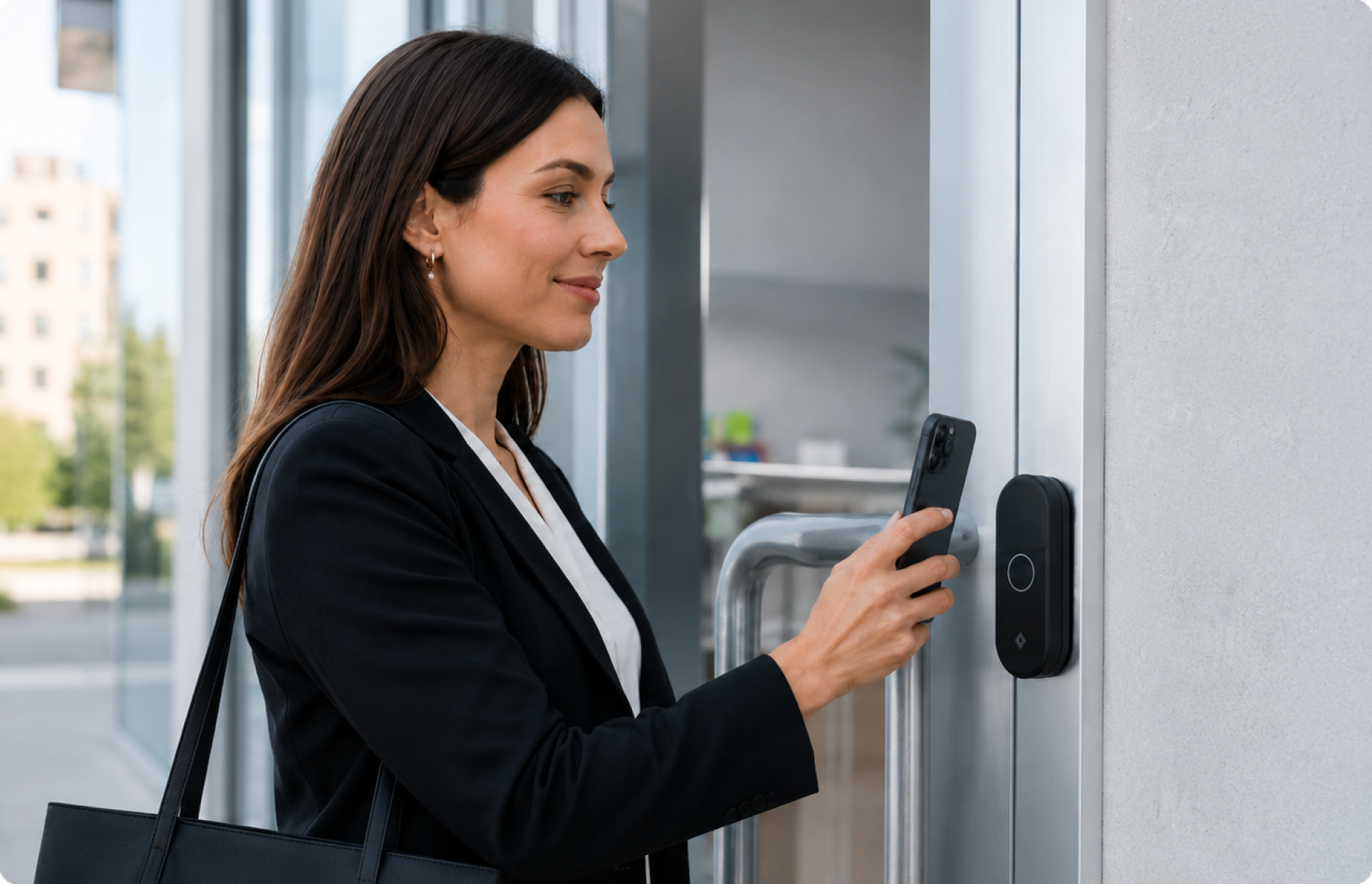
Support for mobile app-based entry, remote provisioning, and multi-site management from a single dashboard is a baseline expectation. Issuing or revoking credentials, adjusting schedules, and initiating lockdowns from a phone or laptop should be standard.
Cybersecurity and Compliance Posture
Encryption in transit and at rest, automatic firmware updates, no default passwords, and third-party attestations like SOC 2 are table stakes. For regulated industries or government-adjacent environments, NDAA and TAA compliance is non-negotiable.
Scalability Across Locations
A smart access control system should manage hundreds of doors across sites from one dashboard without on-site servers at each location. Scalability should be additive (plug in a reader, configure remotely) rather than multiplicative (new server, new cabling, new site visit).
How Rhombus Delivers AI-Powered Access Control
Rhombus meets each of these criteria natively within a unified physical security platform combining cameras, access control, sensors, alarms, and AI analytics.
A Single Platform for Cameras, Access, and AI
Access events, live video, AI alerts, sensor data, and alarm status live in one dashboard, accessible from desktop or mobile. The full Rhombus access control system includes the DC20 Door Controller, DR40 Video Intercom, and DR20 Door Reader.
Native AI Capabilities
Face recognition, license plate recognition, AI Insights, audio analytics, and smart video search are all native to Rhombus, with no third-party bolt-ons or separate licensing tiers. One enterprise customer (Sr. IT Manager, Enterprise Storage and Warehousing Company) reported a “40% reduction in security incidents and a 30% decrease in time spent reviewing footage” after deployment. Full details on the AI analytics suite are on the Rhombus site.
Cloud-Edge Architecture
Rhombus processes data at the edge for low latency and offline operation while the cloud handles centralized management and AI at scale, hosted on AWS with certified infrastructure and redundancy. Doors continue functioning during power outages and internet disruptions according to configured schedules and fail-safe/fail-secure settings. The Rhombus console provides centralized management for all connected devices and sites.
Security and Compliance
Rhombus completed a 12-month independent SOC 2 Type II audit. Controls include no default passwords, automatic firmware updates, tamper detection, encryption in transit and at rest, logical tenant isolation, continuous vulnerability scanning, annual penetration testing, and granular role-based access. Rhombus is NDAA and TAA compliant. Full details at the Rhombus Trust Center.
Open by Design
Rhombus offers a 100% Open API and more than 50 native integrations with enterprise tools including Microsoft, Google, Slack, and Zapier. For organizations with existing camera infrastructure, Relay Core and Relay Lite enable legacy camera migration into Rhombus, protecting prior investments while gaining cloud management and AI analytics.
Frequently Asked Questions
What is AI-powered access control?
AI-powered access control uses machine learning and computer vision to analyze behavior at entry points, detect anomalies, and correlate video with door events. It goes beyond simple credential verification to provide real-time threat detection and actionable intelligence.
How does tailgating detection work?
Camera feeds at entry points use computer vision to count the number of people passing through per credential swipe. When more than one person enters on a single swipe, the system generates an immediate alert.
What is the difference between cloud-native and cloud-hosted access control?
Cloud-native systems are architected for the cloud from the ground up, delivering automatic updates, microservices scalability, and centralized management by design. Cloud-hosted systems are legacy software running in a remote data center, still carrying the architectural limitations of their original on-premise design.
Can AI access control work during a power outage or internet disruption?
Yes. Cloud-edge architectures like Rhombus process data locally at the edge, so doors continue operating according to configured schedules and fail-safe/fail-secure settings even when connectivity is lost.
What compliance certifications should I look for in an access control system?
At minimum, look for SOC 2 Type II attestation, encryption in transit and at rest, and no default passwords. Organizations in government or regulated industries should require NDAA and TAA compliance.
Do I need to replace my existing cameras to use AI access control?
Not necessarily. Rhombus offers Relay Core and Relay Lite, which enable legacy camera migration into the Rhombus platform so you can retain existing hardware while gaining access to cloud management and AI analytics.
See Rhombus in Action
If you are evaluating AI-powered access control, the fastest next step is seeing Rhombus in operation.
Request a demo to see how Rhombus unifies cameras, access control, sensors, and AI analytics in a single platform.
%20--%3e%3csvg%20version='1.1'%20id='Layer_1'%20xmlns='http://www.w3.org/2000/svg'%20xmlns:xlink='http://www.w3.org/1999/xlink'%20x='0px'%20y='0px'%20viewBox='0%200%20110%20110'%20style='enable-background:new%200%200%20110%20110;'%20xml:space='preserve'%3e%3cstyle%20type='text/css'%3e%20.st0{fill:url(%23SVGID_1_);}%20%3c/style%3e%3cg%3e%3clinearGradient%20id='SVGID_1_'%20gradientUnits='userSpaceOnUse'%20x1='25.325'%20y1='766.725'%20x2='84.725'%20y2='707.325'%20gradientTransform='matrix(1%200%200%201%200%20-682)'%3e%3cstop%20offset='0'%20style='stop-color:%23006F94'/%3e%3cstop%20offset='1'%20style='stop-color:%2300C1DE'/%3e%3c/linearGradient%3e%3cpath%20class='st0'%20d='M106.9,47.5L62.5,3.1c-4.1-4.1-10.9-4.1-15,0L3.1,47.5c-4.1,4.1-4.1,10.9,0,15l44.4,44.4%20c4.2,4.2,10.9,4.2,15.1,0L107,62.5C111,58.4,111,51.6,106.9,47.5z%20M55.5,71.2c-9.4,0.3-17-7.3-16.7-16.7C39.1,46,46,39.1,54.5,38.8%20c9.3-0.3,17,7.3,16.7,16.7C70.9,64,64,70.9,55.5,71.2z'/%3e%3c/g%3e%3c/svg%3e)
Related Articles