Back to blog home
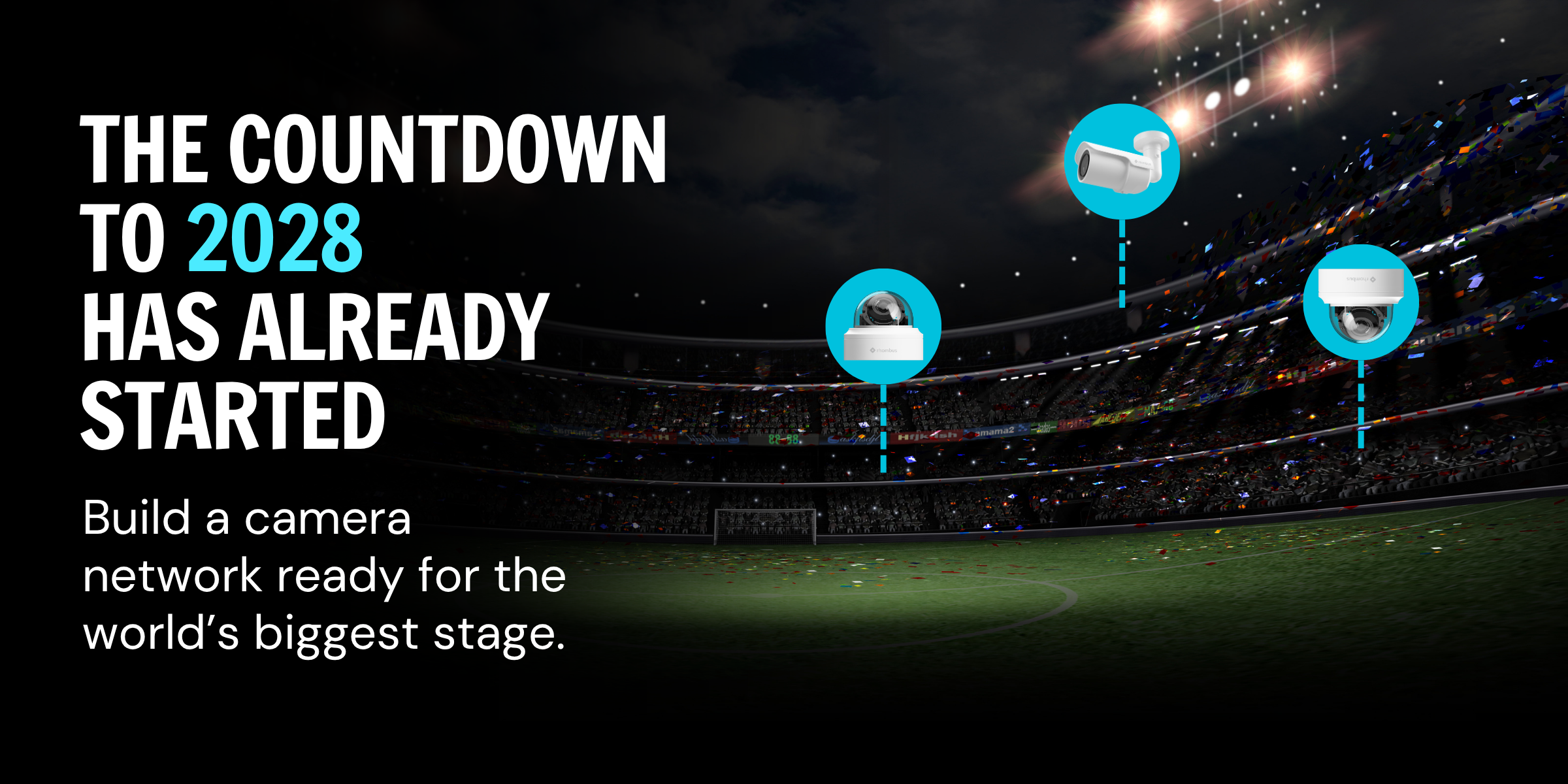
Is Your Camera Network Ready for Seven Super Bowls a Day?
by Team Rhombus, on June 26th, 2026
Physical SecurityThe organizers of LA28 testified before the Senate Homeland Security Committee that the 2028 Olympics will be the equivalent of hosting seven Super Bowls a day, every day, for 16 consecutive days, across 49 competition venues.
SoFi Stadium in Inglewood will become the largest swimming venue in Olympic history and will anchor the Opening Ceremony. The Rose Bowl in Pasadena will host the soccer medal matches. The Long Beach waterfront will become a [cluster of beach and arena events. Even cities without a venue will sit inside the operational footprint. A gateway city like Santa Monica will absorb the spectator surge and the federal security perimeter whether or not a single event takes place within its limits.
Here is the part that does not make the highlight reel. Most municipal camera networks were specified for ordinary days. They were sized for normal call volume, normal retention windows, and a normal number of agencies asking for footage. The Games are a stress test that finds every gap at once, and they arrive on a fixed date you cannot move.
The question isn’t whether your city has enough cameras.
It’s whether the network behind those cameras is built for event-scale operations.
Why “add more cameras” is the wrong first question
Adding cameras is often the first instinct, but it’s rarely the first limitation.
During large public events, operational challenges usually appear somewhere else:
- Can footage be retained long enough for complex investigations?
- Can hundreds of cameras be managed remotely if physical access becomes restricted?
- Can footage be securely shared across multiple agencies with a clear chain of custody?
- Will the system continue recording if connectivity is disrupted?
A network with excellent coverage can still struggle if every footage request requires manual exports or if administrators must travel to individual sites for routine maintenance.
Event readiness is measured by operational resilience—not simply by camera count.
Score yourself in five questions
Coverage and blind spots.
You are in good shape when your cameras and gaps are mapped against crowd flow and perimeter zones, not just a floor plan from years ago. If that map does not exist yet, drawing it is the cheapest high-value move on this list, and it is mostly a desk exercise.
Retention and storage.
You are set when you can hold footage long enough, and extend the window for an active investigation, without re-architecting anything. If retention tightens under load today, this is the gap to close early, because storage has the longest lead time and the most predictable fix.
Remote fleet management.
This is the one that pays off the most: when you can configure and diagnose every camera from a laptop, event day stops depending on who can physically reach a site. If a firmware push still means a truck roll, closing that gap buys you more operational freedom than anything else here.
Multi-agency sharing and chain of custody.
You are ready when you can hand a specific clip to the right person, for a set time, with a record of who opened it. Under a National Special Security Event the Secret Service leads, the FBI owns intelligence, and FEMA owns recovery, and any of them may ask. With this in place, a federal footage request becomes a two-minute task instead of a scramble.
Uptime and resilience.
You are covered when footage survives a network drop and a dead camera pages you in real time, instead of surfacing when you go looking for a clip that was never there. Getting here is what makes the other four worth having: footage you can count on the moment it matters.
Fund your weakest dimension first
Your readiness is set by the weakest of the five, not the average.
Begin by inventorying your existing infrastructure and identifying the areas most likely to create friction under increased demand. Address storage and infrastructure upgrades early, since they typically require the longest procurement cycles. As the event approaches, focus on operational workflows, remote management, and coordination exercises with partner agencies.
One additional consideration deserves attention from the beginning: organizations using federal funding should confirm that any new equipment meets NDAA Section 889 requirements. Identifying compliance issues early helps avoid procurement delays later in the project.
The 24-month sequence
Readiness does not have to land on one budget cycle. Sequenced well, it spreads across the runway you have.
Months 24 to 18: Baseline.
Inventory every camera and recorder. Score the fleet against the five questions above. Critically, run a procurement check on anything you plan to buy with grant dollars. Federal funding tied to the Games carries strings: NDAA Section 889 reaches not just federal agencies but organizations spending federal grant money, which means a non-compliant camera can quietly jeopardize the funding that paid for it. Catch that now, not at reimbursement.
Months 18 to 12: Close the slow gaps.
Fix blind spots and retention first, because storage and camera procurement have the longest lead times. These are the dimensions you cannot fix in the final quarter.
Months 12 to 6: Stand up management and sharing.
Get remote fleet management in place. Define role-based access. Document the multi-agency request workflow before you need it, and run a credentialing dry run with the partners who will actually ask for footage.
Months 6 to 0: Rehearse.
Run tabletop exercises. Test failover for real. Lock your retention policy for the event window. Brief council and constituents on what the cameras do and do not do, before the perimeter goes up rather than after.
What event-ready actually takes
Picture the network that answers yes to all five questions. Updating cameras without a site visit, holding and extending footage on policy, sharing clips with an audit trail, and surviving a network drop are native to cloud-managed platforms. On legacy DVR and NVR systems they are bolted on, or missing.
To be straight about the tradeoff: on-premise systems give you local control and no dependency on bandwidth, which genuinely matters for some sites. But under event load, the operational weight of on-prem, the truck rolls, the manual exports, the per-site patching, is exactly what buckles when movement is restricted and requests spike. The gap between a network that needs a technician on site for every change and one that manages itself remotely is structural, not cosmetic, and it is measured in the procurement and installation cycles you have left before July 2028.
This is the category Rhombus is built for: cloud-managed video security with remote fleet management, governed sharing, and an NDAA and TAA-compliant supply chain that keeps grant-funded deployments clean.
Start this week
The first useful step is free and needs no sign-off. Score your own network against the five questions this week, and you will know within an hour where your runway is shortest and where 2028 will test you first. From there it is a planning problem, not an emergency, which is exactly the position you want to be in with two years of lead time.
When the five questions point to a gap worth closing, that is the moment to see how a cloud-managed platform like Rhombus is built to close it, while you still have the runway to choose deliberately rather than under pressure.
%20--%3e%3csvg%20version='1.1'%20id='Layer_1'%20xmlns='http://www.w3.org/2000/svg'%20xmlns:xlink='http://www.w3.org/1999/xlink'%20x='0px'%20y='0px'%20viewBox='0%200%20110%20110'%20style='enable-background:new%200%200%20110%20110;'%20xml:space='preserve'%3e%3cstyle%20type='text/css'%3e%20.st0{fill:url(%23SVGID_1_);}%20%3c/style%3e%3cg%3e%3clinearGradient%20id='SVGID_1_'%20gradientUnits='userSpaceOnUse'%20x1='25.325'%20y1='766.725'%20x2='84.725'%20y2='707.325'%20gradientTransform='matrix(1%200%200%201%200%20-682)'%3e%3cstop%20offset='0'%20style='stop-color:%23006F94'/%3e%3cstop%20offset='1'%20style='stop-color:%2300C1DE'/%3e%3c/linearGradient%3e%3cpath%20class='st0'%20d='M106.9,47.5L62.5,3.1c-4.1-4.1-10.9-4.1-15,0L3.1,47.5c-4.1,4.1-4.1,10.9,0,15l44.4,44.4%20c4.2,4.2,10.9,4.2,15.1,0L107,62.5C111,58.4,111,51.6,106.9,47.5z%20M55.5,71.2c-9.4,0.3-17-7.3-16.7-16.7C39.1,46,46,39.1,54.5,38.8%20c9.3-0.3,17,7.3,16.7,16.7C70.9,64,64,70.9,55.5,71.2z'/%3e%3c/g%3e%3c/svg%3e)
Related Articles