Back to blog home
The AI Agent Workforce Is Coming. Your Camera System Isn't Ready.
by Jeremy Gulley, on April 1st, 2026
AI & AutomationRhombus + Claude Series — Introduction
Every enterprise is investing in AI. The mandate from leadership is clear: automate the work that doesn’t need a human, free up your best people for the work that does. It’s showing up as AI agents that file tickets, triage alerts, generate reports, and run workflows that used to take a team of analysts all morning.
But there’s a gap most organizations haven’t noticed yet. The physical world — the cameras in your lobbies, the doors to your server rooms, the sensors in your warehouses — is almost entirely invisible to these AI systems. Most camera platforms were built for a security guard sitting in front of a wall of monitors. They’re designed to be watched by humans, not queried by software.
That’s a problem, because physical security generates some of the most valuable operational data in an enterprise: who’s in the building, what’s happening at the loading dock, which doors opened after hours, whether a site is secured. If your AI initiatives can’t reach that data, you’re automating the digital world while leaving the physical world manual.
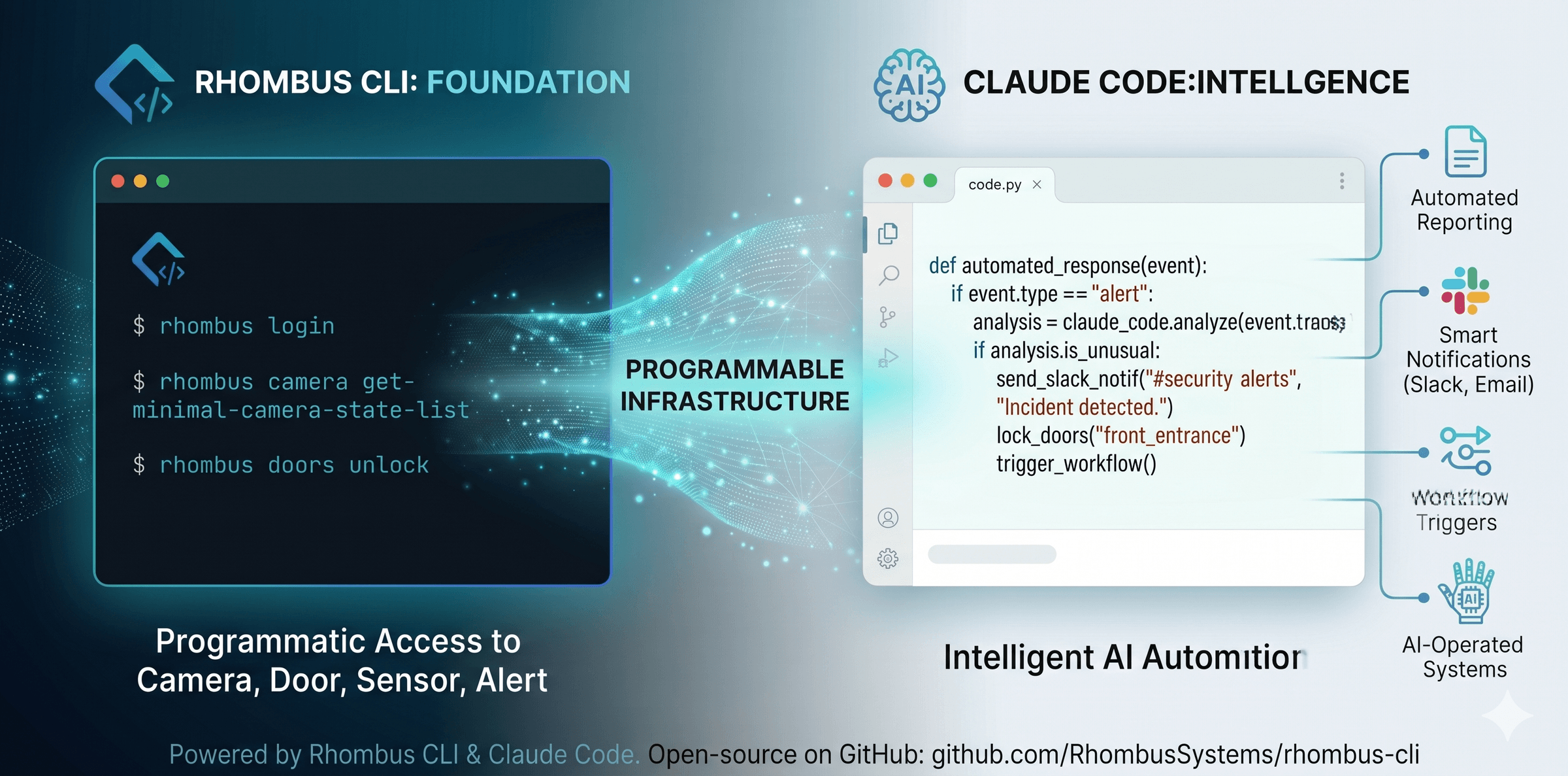
For the developers in the room: Rhombus was designed from day one as an API-first platform. Every camera, door event, and sensor reading is structured data — accessible from a REST API, a CLI, or a natural language prompt to an AI agent. No screen scraping. No legacy protocols. No integrations held together with duct tape.
This series is a tour of what becomes possible when physical security is a first-class citizen in your automation stack. The posts ahead show concrete, minimal examples — often a single prompt or command — of Rhombus working alongside the tools your enterprise already runs: Slack, ServiceNow, PagerDuty, Snowflake, Okta, and more.
Your AI agents are ready. Your camera system should be, too.
%20--%3e%3csvg%20version='1.1'%20id='Layer_1'%20xmlns='http://www.w3.org/2000/svg'%20xmlns:xlink='http://www.w3.org/1999/xlink'%20x='0px'%20y='0px'%20viewBox='0%200%20110%20110'%20style='enable-background:new%200%200%20110%20110;'%20xml:space='preserve'%3e%3cstyle%20type='text/css'%3e%20.st0{fill:url(%23SVGID_1_);}%20%3c/style%3e%3cg%3e%3clinearGradient%20id='SVGID_1_'%20gradientUnits='userSpaceOnUse'%20x1='25.325'%20y1='766.725'%20x2='84.725'%20y2='707.325'%20gradientTransform='matrix(1%200%200%201%200%20-682)'%3e%3cstop%20offset='0'%20style='stop-color:%23006F94'/%3e%3cstop%20offset='1'%20style='stop-color:%2300C1DE'/%3e%3c/linearGradient%3e%3cpath%20class='st0'%20d='M106.9,47.5L62.5,3.1c-4.1-4.1-10.9-4.1-15,0L3.1,47.5c-4.1,4.1-4.1,10.9,0,15l44.4,44.4%20c4.2,4.2,10.9,4.2,15.1,0L107,62.5C111,58.4,111,51.6,106.9,47.5z%20M55.5,71.2c-9.4,0.3-17-7.3-16.7-16.7C39.1,46,46,39.1,54.5,38.8%20c9.3-0.3,17,7.3,16.7,16.7C70.9,64,64,70.9,55.5,71.2z'/%3e%3c/g%3e%3c/svg%3e)
Related Articles

