Back to blog home
Vape Detectors for Schools: How They Work and What to Look For
by Team Rhombus, on July 15th, 2026
Physical SecurityKey Takeaways
- Vape detectors sense the aerosol students exhale, using particulate sensors alongside chemical sensors that flag VOC signatures tied to nicotine and THC products, and they track air-quality shifts like humidity spikes that signal masking attempts.
- Schools install them in bathrooms and locker rooms because cameras cannot go in those private spaces, leaving a blind spot in an otherwise monitored building.
- The main buying decision is standalone versus connected. A single-purpose detector runs on its own app, while a platform sensor sends alerts into the same console as your cameras and access control.
- Connected sensors let staff correlate a vape alert with nearby camera footage and route notifications through workflows you already run, which shortens response time and reduces the number of separate dashboards to manage.
How vape detectors actually work
A vape detector reads the air, not the room. Instead of pointing a lens at students, it samples the air passing over an internal sensor array and looks for the chemical and physical signatures that vaping leaves behind. Understanding those signatures explains why a good detector fires on an exhaled cloud but ignores a burst of steam from a hand dryer.
Particulate and aerosol sensing
The first thing most detectors watch for is aerosol. When someone exhales a vape cloud, they release a dense burst of ultra-fine particles that hangs in the air longer than ordinary humidity. A particulate sensor measures the concentration and size distribution of those particles and flags a sudden spike that matches the profile of vape aerosol. Particle size and concentration help distinguish a real vaping event from steamy air. The two can overlap enough that particle count alone isn’t always a clean signal, so a quality detector confirms aerosol readings against the chemical data described next.
Aerosol alone is a strong signal, but it is not conclusive. A detector that relied only on particle counts would trip on aerosol cleaners, dust, or a fogged-up mirror. The better systems treat aerosol as one input among several and confirm it against the chemical readings described below before raising an alert.
Chemical detection for THC and nicotine
Chemical sensors give a detector the ability to tell what is in the air, not just that something is in it. Vape products give off volatile organic compounds, or VOCs, which are the gaseous chemicals that evaporate off the e-liquid when it is heated. A VOC sensor tracks the concentration of these compounds and reacts when the mix shifts toward patterns associated with vaping, including many nicotine and THC products.
Some systems can separate nicotine signatures from THC signatures closely enough to help staff calibrate their response, since a suspected THC incident in a high school carries different consequences than a nicotine one. That level of separation varies by product, and no consumer-grade sensor identifies a specific brand or dose. Vendors that claim laboratory-grade precision are overselling. What a quality chemical sensor does reliably is confirm that the aerosol spike came from a vape product rather than an ambient source. Ask any vendor directly how granular their substance detection actually is before you buy.
Air quality baselines and masking attempts
Beyond aerosol and VOCs, detectors monitor the ordinary air quality of the space to catch students who try to hide what they are doing. Many sensors establish a baseline for humidity and temperature in the room during normal use, and some units extend that baseline to carbon dioxide or other air quality metrics. When a reading swings sharply away from that baseline, the detector treats the change as suspicious even if the vape signature itself is faint.
Masking behavior is exactly where the baseline earns its place. Students often spray body spray, run hot water, or crowd a bathroom to dilute or cover a vape cloud, and each of those actions produces its own detectable shift. A spike in humidity paired with a chemical masking agent tells the system that someone is working to obscure the air, and some detectors log this as a separate masking or interference event. Reading the environment as a whole, rather than hunting for one signal, is what keeps a detector useful once students learn it is there.
Sound anomaly detection
Some vape sensors add sound-anomaly detection to the same housing, expanding the device from a single-purpose vape sensor into a broader safety monitor. These sensors listen for acoustic patterns that indicate trouble, such as shouting, aggression, breaking glass, or a smoke-alarm tone. The sensor analyzes the shape of the sound, not the words, so it can flag a fight or an emergency without capturing what anyone actually says.
The line between monitoring and surveillance matters here, especially in bathrooms and locker rooms where privacy is non-negotiable. A properly designed environmental sensor is built to detect an audio anomaly and log an alert event rather than store a recording, though the exact processing approach varies by vendor and is worth confirming directly. It measures air and acoustic signatures rather than capturing images or recordings, which is a meaningfully different category from a camera or microphone, and that lets a district place these devices in private spaces that cameras can never enter.
Why schools are adopting vape detection now
Vaping among students happens in the two places a school camera will never cover. Bathrooms and locker rooms are off-limits for surveillance under student privacy expectations and, in most districts, board policy. So while hallways, entrances, and common areas sit under camera coverage, students learn quickly that the restroom is the one room where no one is watching. Vape detection exists to close that specific gap.
The behavior driving adoption is concrete. E-cigarette use spiked among high school and middle school students over the past several years, and many of the devices are small enough to conceal in a fist. THC vaporizers add a second problem, since they carry the same discreet form factor and leave a similar aerosol signature. A student can take a hit between classes and be back at a desk in under a minute, and staff standing in a hallway have no way to know it happened one door away.
Administrators have tried the low-tech fixes and found the limits. Some schools removed bathroom doors or stationed staff nearby, which strains supervision budgets and creates its own privacy and dignity concerns for students. Others restricted bathroom access during class periods, which punishes everyone for the behavior of a few and generates complaints from parents. None of these approaches tells you when vaping actually occurs, so they neither deter the behavior nor help staff respond to it.
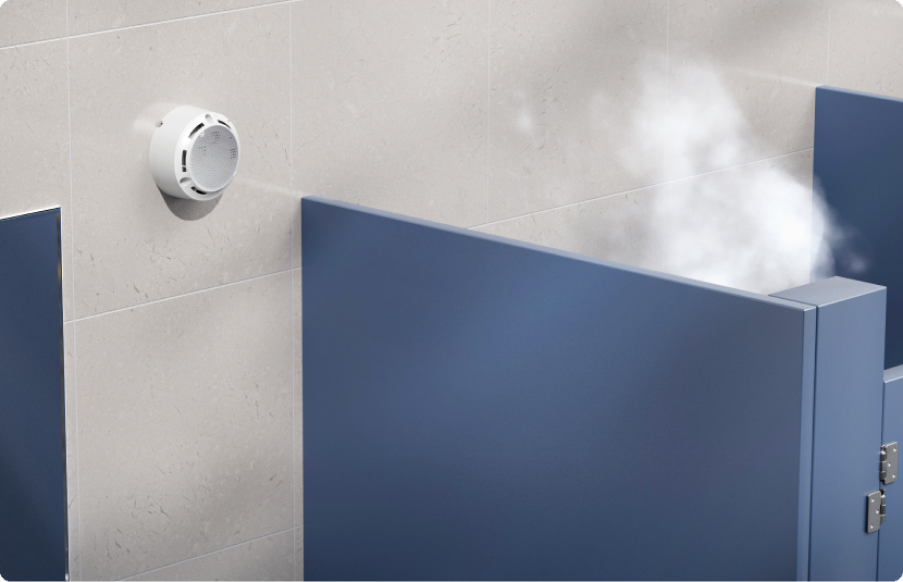
A vape sensor works differently because it reports on the air rather than the people in the room. The device sits on the ceiling, samples for aerosol and chemical signatures, and sends an alert when it detects them. No one has to watch a monitor, and no footage of students exists to review, because the detector never captures images or, in most configurations, audio content. It monitors an environmental condition and flags a change, which is why districts can deploy it in spaces where a camera would be indefensible.
Every detector on the market claims to sense vape aerosol, so the meaningful differences show up elsewhere. How accurately does it distinguish a vape cloud from steam or aerosol deodorant, how quickly does an alert reach the staff member who can respond, and how well does the unit resist a student who figures out where it sits and tries to cover or disable it? Those questions decide whether a system earns staff trust or gets ignored after the third false alarm, so weigh them before you compare products.
What to look for in a vape detection system
Detection accuracy is the first thing to test, because a sensor that misses vape aerosol or flags a can of air freshener as THC will erode staff trust within a week. A good sensor reads several signals at once. It should register the fine aerosol particles from an e-cigarette, detect the volatile organic compounds tied to nicotine and THC, and track baseline shifts in humidity or air quality that show up when a student tries to mask vapor with steam or scent. Ask vendors what specific substances a unit distinguishes, and how it separates a vape event from ordinary bathroom activity like hairspray or cleaning products.
Pay close attention to the false-alarm rate, because it drives whether staff act on alerts or start ignoring them. When a detector fires ten times a day for things that turn out to be nothing, teachers and administrators learn to treat every notification as noise. That response fatigue defeats the purpose of installing sensors at all. Ask for documented false-positive performance under real conditions rather than lab claims, and ask how the vendor handles firmware tuning after installation. A system you can adjust to your building’s normal air patterns will settle into far fewer nuisance alerts than one with fixed thresholds.
Consider whether the detector layers in signals beyond air chemistry. Some units add sound-anomaly detection that flags shouting, aggression, or breaking glass without recording conversations, which matters in locker rooms and bathrooms where fights and bullying happen out of camera view. Treat that capability as a bonus rather than a substitute for vape sensing. A unit that does both gives you one device covering two blind spots, but confirm the audio analysis reports events rather than storing recordings, since that distinction shapes both privacy policy and parent conversations.
How alerts reach your staff
Real-time alert routing determines whether a detection turns into a response or just a log entry. The strongest systems push notifications to staff phones and a central dashboard the moment a threshold trips, so a nearby administrator can walk to the bathroom within a minute instead of reading about the incident the next morning. Ask how alerts are delivered, whether you can route them to specific people by building or zone, and whether the notification includes enough context (which sensor, what triggered it, what time) for staff to act without guessing. A sensor that only stores data for later review does little to stop an incident in progress.
Look at how the system handles escalation and acknowledgment. If an alert goes unanswered, does it move up to the next person on the list, or does it sit silently? Districts with multiple buildings need routing that respects who is on site and on duty at a given hour, and they need a record of who responded so patterns become visible over time. Confirm the platform lets you set these rules yourself rather than requiring a support ticket for every change.
Tamper resistance and installation
Tamper resistance keeps a detector working once students figure out where it is. Vaping in a bathroom is often deliberate, and a device that can be covered, unplugged, or knocked offline without anyone knowing is a device students will defeat. Look for a sealed housing that resists tampering and a sabotage alert that fires when a sensor is blocked, disconnected, or loses power. That alert matters as much as the vape detection itself, because a sudden loss of signal from one bathroom tells you exactly where to look.
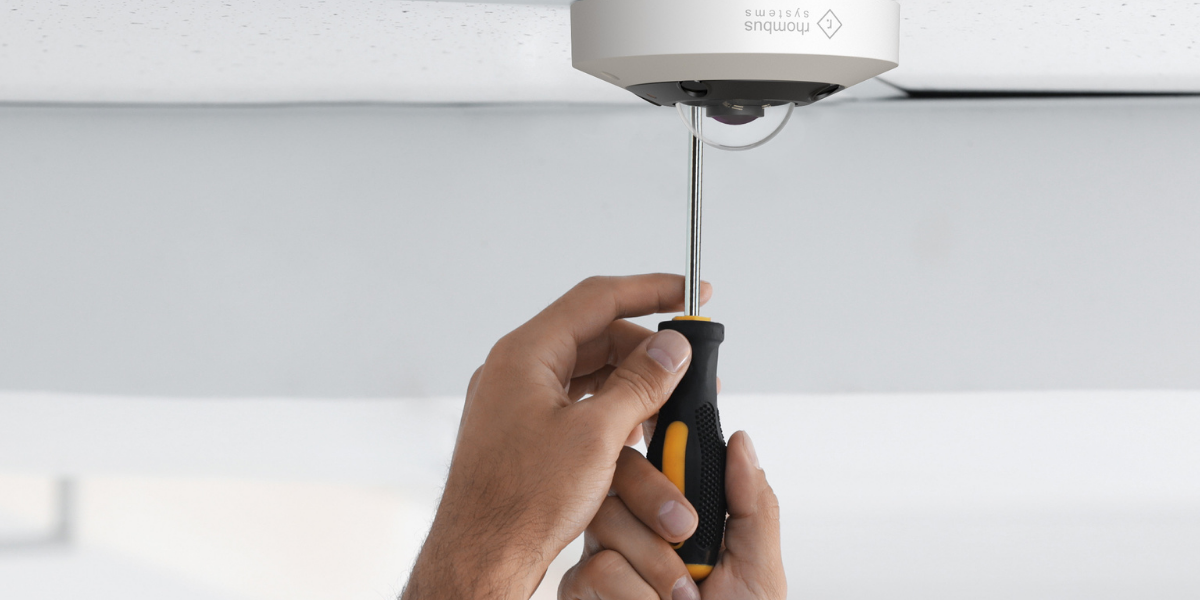
Match the installation method to your building before you commit. Wired sensors draw steady power and connectivity, which suits new construction or a retrofit where you can run cable to the ceiling. They also avoid the maintenance cycle of replacing batteries across dozens of rooms. Battery units install faster and reach spaces without nearby wiring, at the cost of ongoing battery management and the risk of a dead unit going unnoticed. Ceiling mounting is standard, since it places the sensor near where vapor rises and keeps it out of easy reach. Ask the vendor for a placement guide, because a detector mounted too far from stalls or too close to a vent will read poorly regardless of how good the sensing hardware is.
Weigh the retrofit picture honestly. If you are adding detectors to an existing building, count the labor of running power or the recurring cost of batteries alongside the hardware price, since installation often costs more than the sensors themselves. A district planning to cover every bathroom across several schools should ask whether the vendor supports phased rollout and whether new sensors join the existing setup without a separate controller for each building. Factor in calibration too. Sensors need their baselines tuned to each room after installation, and ask the vendor how that process works and whether it requires a technician visit or can be adjusted remotely as conditions change.
Turning criteria into an RFP
Turn these points into questions you put to every vendor in writing. Ask what substances each unit detects and how it suppresses false alarms, how alerts route and escalate, what tamper protection and sabotage alerting the housing provides, and what the installation requires for your specific buildings. Vendors that answer with documented specifications and placement guidance are easier to trust than those that answer with marketing claims. Those answers also make competing bids comparable, so you evaluate systems on the same measurable attributes rather than on which sales deck looked most polished.
Standalone detectors vs. connected safety platforms
Once you trust a detector to sense vape aerosol and flag air quality shifts, the next decision shapes how the device fits into everything else your school already runs. You can buy a standalone detector that does one job well, or you can install a sensor that reports into the same platform as your cameras, access control, and staff alerting. That choice affects cost, day-to-day management, and how fast staff can act when an alert fires.
Standalone detectors are simpler to buy and understand. Each unit senses vape and pushes an alert to its own app or a dedicated dashboard. For a single school piloting the technology in a handful of bathrooms, a point solution can be enough to prove the concept and justify a wider rollout. The tradeoff shows up as you scale. A district with a dozen buildings ends up managing a separate app, a separate login, and a separate set of firmware updates for each device line, and no single screen shows what is happening across the whole campus.
Connected sensors solve the coordination problem by reporting into a platform you already operate. When a vape alert lands in the same console that holds your camera footage and door events, a staff member can see the alert, check the hallway camera outside the affected bathroom, and confirm who entered before responding. The alert also routes through notification workflows you have already set up, so it reaches the right phone or radio without a new app to check. That correlation between a sensor event and nearby footage turns a raw alert into context a responder can act on.
The tradeoffs are real in both directions, so weigh them against how your district actually operates rather than picking on principle. A standalone detector carries a lower entry cost and no dependency on a larger system, which suits a school running its cameras and access control on separate, older infrastructure. A connected sensor costs more to adopt if you do not already run a compatible platform, but it lowers the ongoing management burden and shortens response time once that platform is in place. Districts standardizing on one security vendor tend to favor the connected approach because it avoids adding another isolated tool for facilities and safety teams to monitor.
Response speed is where the two models separate most clearly. With a standalone detector, a staff member gets a notification, then has to open a camera system in a different tool to figure out what is going on, which adds minutes when minutes matter. A connected sensor collapses those steps into one interface, so the person receiving the alert sees the video and the door activity in the same place. For an aggression or fight alert layered onto a vape sensor, that saved time changes whether an administrator arrives during the incident or after it.
Management overhead compounds as a district grows. One dashboard for every sensor, camera, and door means one place to add users, set permissions, and pull reports when a parent or board member asks what happened. Separate apps per device force your team to reconcile timestamps and logins across systems by hand, and that friction usually means alerts get checked less often, not more. For a small deployment the difference is minor, but across a district it decides whether the technology gets used the way you intended.
Neither model is automatically correct. A single school testing the waters may be better served by a standalone unit it can install and evaluate without touching the rest of its infrastructure. A district planning to cover every building and correlate incidents across campuses will get more from sensors that fold into a platform it already trusts. How many sites you cover, what systems you already run, and how quickly you need staff to respond will point to the right answer.
Comparison: standalone vape detectors vs. connected platform sensors
| Attribute | Standalone vape detector | Connected platform sensor |
|---|---|---|
| Detection scope | Vape aerosol and VOC signatures, with some units adding sound anomalies. Each device works in isolation. | Vape aerosol, VOC signatures, and air-quality shifts, sensed alongside cameras and access events on the same network. |
| Alerting method | Sends alerts through the device’s own app or an email list specific to that product. | Routes alerts through the shared console and existing notification workflows staff already use for other incidents. |
| Integration with cameras and access control | None by default. An alert in the bathroom cannot be tied to who entered or what a nearby camera saw. | An alert links to footage from cameras outside the space and to badge or door records, so staff see context before responding. |
| Management overhead | Grows with each product line. A separate app, login, and firmware process per device type. | One dashboard covers sensors, cameras, and doors, so a facilities team manages fewer tools. |
| Scalability across a district | Adding buildings means repeating single-purpose installs and managing more disconnected apps. | New sensors join the same account and inherit existing alert rules, which keeps a multi-school rollout consistent. |
The tradeoff comes down to what you already run. A single building with no other connected security may find a standalone unit simpler to buy. A district that already operates cameras and access control usually spends less time managing a sensor that reports into the same place.
How connected platforms close the response gap
A vape detector that only sends an alert leaves staff guessing about what actually happened. A connected platform answers the question by pairing the alert with everything else the building already records. When a vape sensor in a bathroom fires, the staff member responding wants to know who walked in during the two minutes before the reading spiked. A camera at the bathroom entrance holds that answer, and a shared console puts the alert and the footage side by side instead of in two separate apps.
Rhombus’s E50 environmental sensor works this way. The E50 detects vape and smoke particles alongside air-quality shifts, and it reports into the same console that manages your cameras and access control. Because the sensor and the cameras live in one system, an alert from the E50 automatically links to camera clips from the same timeframe and nearby entrances. A dean checking the notification sees the reading and the entry footage together, which turns a vague “something happened in the west wing bathroom” into a specific incident with a timeline.
Access control data adds a second layer to that correlation. If your doors use badge or credential entry, the console can show which credentials unlocked nearby doors around the time of the alert. That context narrows a response from a building-wide search to a short list, and it does so without any camera in the bathroom itself. Privacy stays intact because the detection happens through air-quality sensing, while the identifying detail comes from footage and access logs outside the restricted space.
Routing matters as much as correlation. A detector that only lights up a wall panel depends on someone standing nearby. A connected platform pushes the alert through the notification workflows a district already runs. Rhombus offers integrations with mass-notification platforms including Omnilert and Raptor Alert, which many districts already use for broader safety alerting, and districts should confirm with Rhombus directly which specific alert types, including environmental sensor events, are supported through those integrations for their deployment. You configure who gets notified, on which device, and under what conditions once, and every sensor you add later follows those rules. A new E50 in a locker room routes through the same path as the sensor installed last semester, with no separate app to manage.
Response time and overhead are where this plays out most concretely. Consider a district running vape detection across a dozen buildings. With standalone units, each device carries its own alert method and its own dashboard, and an administrator checking on a reading logs into one interface, then opens the camera system separately to find matching footage. With a connected platform, that same administrator opens one console, sees the alert, watches the linked clip, and dispatches a staff member through the existing notification path. The steps that consume the first critical minutes collapse into a single screen.
None of this replaces the detection basics covered earlier. A connected sensor still needs accurate aerosol and chemical sensing, a low false-alarm rate, and tamper resistance to be worth installing. The platform layer determines what your staff can do with a good reading once it arrives, not whether the reading is accurate. For a district that already runs cameras and access control, folding vape detection into that same system means the response process you built for other incidents extends to vaping automatically, rather than starting a new one from scratch for a single class of device.
Frequently asked questions
Do vape detectors record audio or video?
Generally, no. Vape detectors are built to monitor air quality and sound patterns, not conversations or images. The Rhombus E50, for example, measures particulates, chemical signatures, and audio characteristics such as glass break or a loud noise spike. Public product documentation describes this as detection of sound events rather than audio recording, though districts should confirm the exact data handling and retention behavior directly with any vendor before installation, since implementations and disclosures vary. The distinction matters in bathrooms and locker rooms, where privacy rules out cameras and microphones.
Are vape detectors legal in schools?
Yes, in general. Because vape detectors sense air quality and sound anomalies rather than recording audio or video, they avoid the privacy concerns that keep cameras out of bathrooms and locker rooms. Most districts install them in exactly those spaces for that reason. Specific rules vary by state and district, so your legal counsel or district policy team should confirm placement and notification requirements before deployment. As a practical matter, air-quality monitoring is widely treated the same way as smoke or carbon monoxide detection.
How fast do alerts trigger?
Most quality systems alert within seconds to a couple of minutes of a detection event, though exact speed varies by vendor and network conditions. When a sensor identifies vape aerosol or a sudden air-quality shift, it sends a notification to staff phones or a central dashboard close to real time. On a connected platform, that alert can route through existing notification workflows and pair with nearby camera footage from the hallway outside, so staff know where to respond before the vapor clears. Response speed depends heavily on how alerts are routed and who receives them, which is why alert configuration deserves attention during setup. Ask any vendor for their documented alert latency rather than assuming.
What is the difference between a vape sensor and a smoke detector?
A smoke detector responds to combustion particles from fire, while a vape sensor detects the fine aerosol and chemical compounds produced by e-cigarettes. Standard smoke alarms are not designed to reliably catch vape aerosol, since it does not consistently match the smoke signature those devices look for, which is why schools relying only on fire alarms miss most vaping incidents. A vape sensor is tuned to detect vape-specific aerosol and VOC signatures and often tracks humidity shifts that spike when someone vapes. The two devices serve different purposes and are not interchangeable.
Do vape detectors produce a lot of false alarms?
Quality units keep false alarms low, but no sensor is perfect. Steam from showers, aerosol sprays, and cleaning products can trigger a poorly calibrated device, which erodes staff trust and creates response fatigue. Systems that layer multiple signals, such as particulate readings alongside chemical detection, filter out routine environmental noise more reliably than single-signal units. Ask any vendor how their device distinguishes vape aerosol from ordinary bathroom conditions.
Where should vape detectors be installed?
Mount them in the enclosed spaces where cameras cannot go, primarily bathrooms and locker rooms. Ceiling placement gives the sensor even coverage of the room, and units come in wired or battery-powered versions to fit both retrofit and new-construction projects. Position them away from vents and windows that could dilute readings. Tamper-resistant housing and sabotage alerts help in student-accessible areas where a device may be covered or moved.
Getting started with vape detection at your school
Start by mapping where cameras leave gaps. Walk your bathrooms and locker rooms, count the fixtures, and note ceiling height and whether you can run power to those spots. Those constraints decide whether a wired ceiling mount or a battery unit fits, and they shape how many sensors a full building needs before you ever talk to a vendor.
Decide next whether you want a point solution or a sensor that reports into the platform you already run. If your district manages cameras and door access from one console, adding vape and air-quality detection to that same console cuts the number of apps your staff monitor and lets an alert pull up nearby footage in seconds. A standalone detector can work, but it adds another login and another dashboard for an already stretched safety team.
Bring your IT and facilities leads into the evaluation early. They will flag network capacity, mounting logistics, and how alerts route to staff phones. Their input keeps a pilot from stalling after you purchase. Run a small trial in one or two of your highest-traffic bathrooms before committing to a district-wide rollout, so you can measure the false-alarm rate against your own building rather than a spec sheet.
If a connected approach fits how you already manage security, see how Rhombus environmental monitoring sensors work and how vape and air-quality detection tie into the same console as your cameras and access control. Rhombus’s school security resources walk through how districts structure incident response across those systems.
Ready to see detection and alerting on one platform? Request a demo and see how the E50 sensor and your existing camera coverage work together.
%20--%3e%3csvg%20version='1.1'%20id='Layer_1'%20xmlns='http://www.w3.org/2000/svg'%20xmlns:xlink='http://www.w3.org/1999/xlink'%20x='0px'%20y='0px'%20viewBox='0%200%20110%20110'%20style='enable-background:new%200%200%20110%20110;'%20xml:space='preserve'%3e%3cstyle%20type='text/css'%3e%20.st0{fill:url(%23SVGID_1_);}%20%3c/style%3e%3cg%3e%3clinearGradient%20id='SVGID_1_'%20gradientUnits='userSpaceOnUse'%20x1='25.325'%20y1='766.725'%20x2='84.725'%20y2='707.325'%20gradientTransform='matrix(1%200%200%201%200%20-682)'%3e%3cstop%20offset='0'%20style='stop-color:%23006F94'/%3e%3cstop%20offset='1'%20style='stop-color:%2300C1DE'/%3e%3c/linearGradient%3e%3cpath%20class='st0'%20d='M106.9,47.5L62.5,3.1c-4.1-4.1-10.9-4.1-15,0L3.1,47.5c-4.1,4.1-4.1,10.9,0,15l44.4,44.4%20c4.2,4.2,10.9,4.2,15.1,0L107,62.5C111,58.4,111,51.6,106.9,47.5z%20M55.5,71.2c-9.4,0.3-17-7.3-16.7-16.7C39.1,46,46,39.1,54.5,38.8%20c9.3-0.3,17,7.3,16.7,16.7C70.9,64,64,70.9,55.5,71.2z'/%3e%3c/g%3e%3c/svg%3e)
Related Articles