Back to blog home
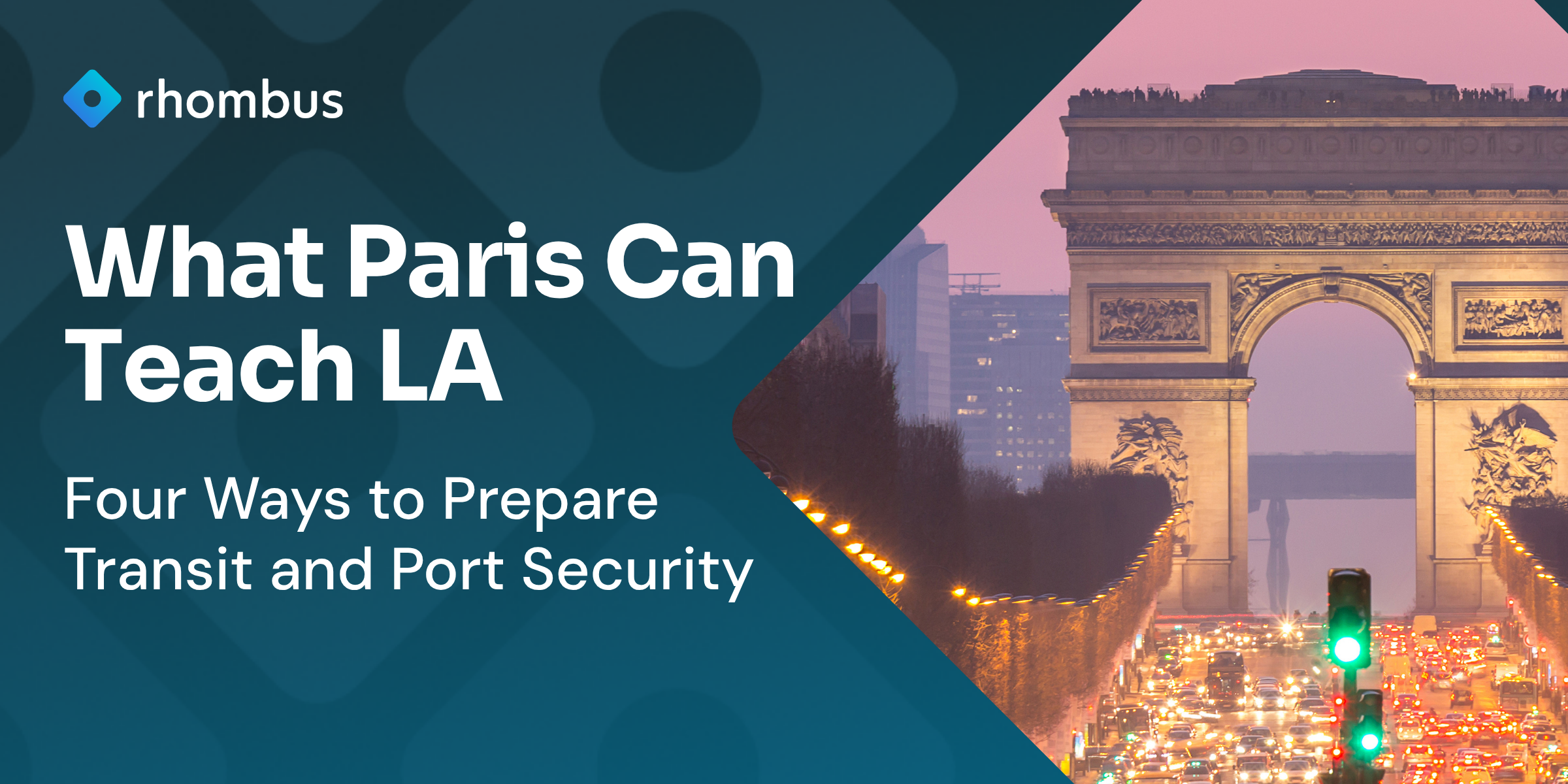
What Paris Can Teach LA: Four Ways to Prepare Transit and Port Security for 2028
by Team Rhombus, on June 25th, 2026
Physical SecurityIn July 2028, Los Angeles will host the largest event in the world. For the agencies that move the region’s people and goods, that is both a real security challenge and a rare chance to modernize infrastructure that will serve riders and operations long after the closing ceremony.
The good news is that this problem has been solved before, recently and at-scale. Paris, London, and Tokyo all stood up complex, multi-agency security operations for their Games, and the playbook they left behind is detailed and public. LA City Council President Paul Krekorian has called security the city’s single biggest concern for 2028, fitting for “the biggest event in the world,” and the federal process that coordinates it has already been running for over a year.
So rather than start from a blank page, transit and port operators can borrow from what has worked. Here are four practical ways to get ahead of it.
1. Map the footprint that doesn’t yet exist
The first instinct is to audit the cameras you have. The more useful exercise is to map the sites you don’t.
A Games operation bolts a temporary network on top of the one you run every day. For 2028, Metro’s plan alone calls for thousands of supplemental buses, more than 10,000 new personnel, and a route network of staging depots, park-and-ride lots, and mobility hubs that will run for about 60 days and then come down. Metrolink will carry crowds to outlying venues. And the region’s ports won’t pause for any of it: cargo keeps moving across sprawling terminals while global scrutiny lands on Southern California’s critical infrastructure all at once. None of those surge points are on your coverage map today, because most of them don’t exist yet.
Operators who run big events know where the gap lives. “We have great coverage inside our ballpark,” the Philadelphia Phillies’ director of operations and security said, before describing the work it took to cover everything around it. At the Caesars Superdome, the public safety team swells to roughly 3,000 people on event days. The lesson: start by listing every place a crowd will gather that your permanent system was never built to see, then plan coverage for those first.
2. Plan for a shared picture across agencies
Security at an event this size is never one organization’s job. The 2028 Games will be a shared responsibility across federal, state, county, and city agencies, with your operation feeding into the larger picture.
This is exactly where Paris is instructive. Rather than let each operator watch its own cameras in isolation, the region ran transport security from a single coordination center that brought the police, the national railway, and the metro operator together, with shared visibility across the network. By the time the Games arrived, that center could see well over 100,000 cameras across the system.
The takeaway for LA operators is to settle the coordination questions early. Who will need access to your footage during the Games? How will you grant it without standing up a parallel system in the final months? Cross-agency visibility is far easier to design in from the start than to bolt on under deadline. Decide now how your footage will be shared, and with whom.
3. Stage a Dress Rehearsal
Here is the part that is easy to underestimate: the most valuable thing a fixed event date gives you is time to practice.
A security system you deploy and immediately depend on, with no chance to test it, is a liability dressed up as preparation. The agencies that looked smooth in past Games budgeted for the unglamorous work of integration, dry runs, and staff training before anyone relied on the system live. Paris began its security coordination roughly two years out, not because the technology took that long to install, but because the people and the procedures needed time to gel.
Working backward from the event and protecting a real testing window is simply good planning. It is also the difference between a system your team trusts on the busiest day of the decade and one they are still learning on the fly.
4. Choose infrastructure that can flex
A temporary, distributed, surge-and-recede operation is a specific kind of problem, and not every security architecture handles it well. As you weigh options, a few things matter more for an event than they do for everyday operations:
- How fast can it deploy? Coverage at new and temporary sites should come online in days, without racking recorders and servers at every location.
- Can it be managed centrally? A sprawling, multi-site footprint is far easier to run from one console with remote access than from a dozen disconnected systems.
- Can it scale up and then back down? Look for a platform that can add coverage for the Games footprint and decommission it cleanly afterward, without stranded hardware.
- Is it resilient? Cameras that keep recording through a network interruption and sync when it returns hold up better on a demanding day.
Cloud-managed platforms tend to fit these criteria well, and there is a useful side effect: the infrastructure you stand up for the Games can keep serving daily operations long after it. The best version of this spend is not a temporary expense. It is a permanent upgrade that happens to be ready in time.
The opportunity inside the deadline
It is easy to frame a once-in-a-generation event as a burden. It is more useful to see it as a forcing function for work many agencies already know they need to do.
The operators who came through past Games looking ready treated security planning as exactly that: a chance to modernize, coordinate, and rehearse, on a timeline the world handed them. And the smartest of them compared notes with peers who had hosted before rather than learning everything the hard way. Los Angeles has the same opportunity, and the benefit of a very recent set of examples to learn from.
If you are mapping out what your security operation needs to look like for 2028, our team is happy to talk through what has worked for other large, multi-site operations.
Book a demo to think through your 2028 security plan.
%20--%3e%3csvg%20version='1.1'%20id='Layer_1'%20xmlns='http://www.w3.org/2000/svg'%20xmlns:xlink='http://www.w3.org/1999/xlink'%20x='0px'%20y='0px'%20viewBox='0%200%20110%20110'%20style='enable-background:new%200%200%20110%20110;'%20xml:space='preserve'%3e%3cstyle%20type='text/css'%3e%20.st0{fill:url(%23SVGID_1_);}%20%3c/style%3e%3cg%3e%3clinearGradient%20id='SVGID_1_'%20gradientUnits='userSpaceOnUse'%20x1='25.325'%20y1='766.725'%20x2='84.725'%20y2='707.325'%20gradientTransform='matrix(1%200%200%201%200%20-682)'%3e%3cstop%20offset='0'%20style='stop-color:%23006F94'/%3e%3cstop%20offset='1'%20style='stop-color:%2300C1DE'/%3e%3c/linearGradient%3e%3cpath%20class='st0'%20d='M106.9,47.5L62.5,3.1c-4.1-4.1-10.9-4.1-15,0L3.1,47.5c-4.1,4.1-4.1,10.9,0,15l44.4,44.4%20c4.2,4.2,10.9,4.2,15.1,0L107,62.5C111,58.4,111,51.6,106.9,47.5z%20M55.5,71.2c-9.4,0.3-17-7.3-16.7-16.7C39.1,46,46,39.1,54.5,38.8%20c9.3-0.3,17,7.3,16.7,16.7C70.9,64,64,70.9,55.5,71.2z'/%3e%3c/g%3e%3c/svg%3e)
Related Articles